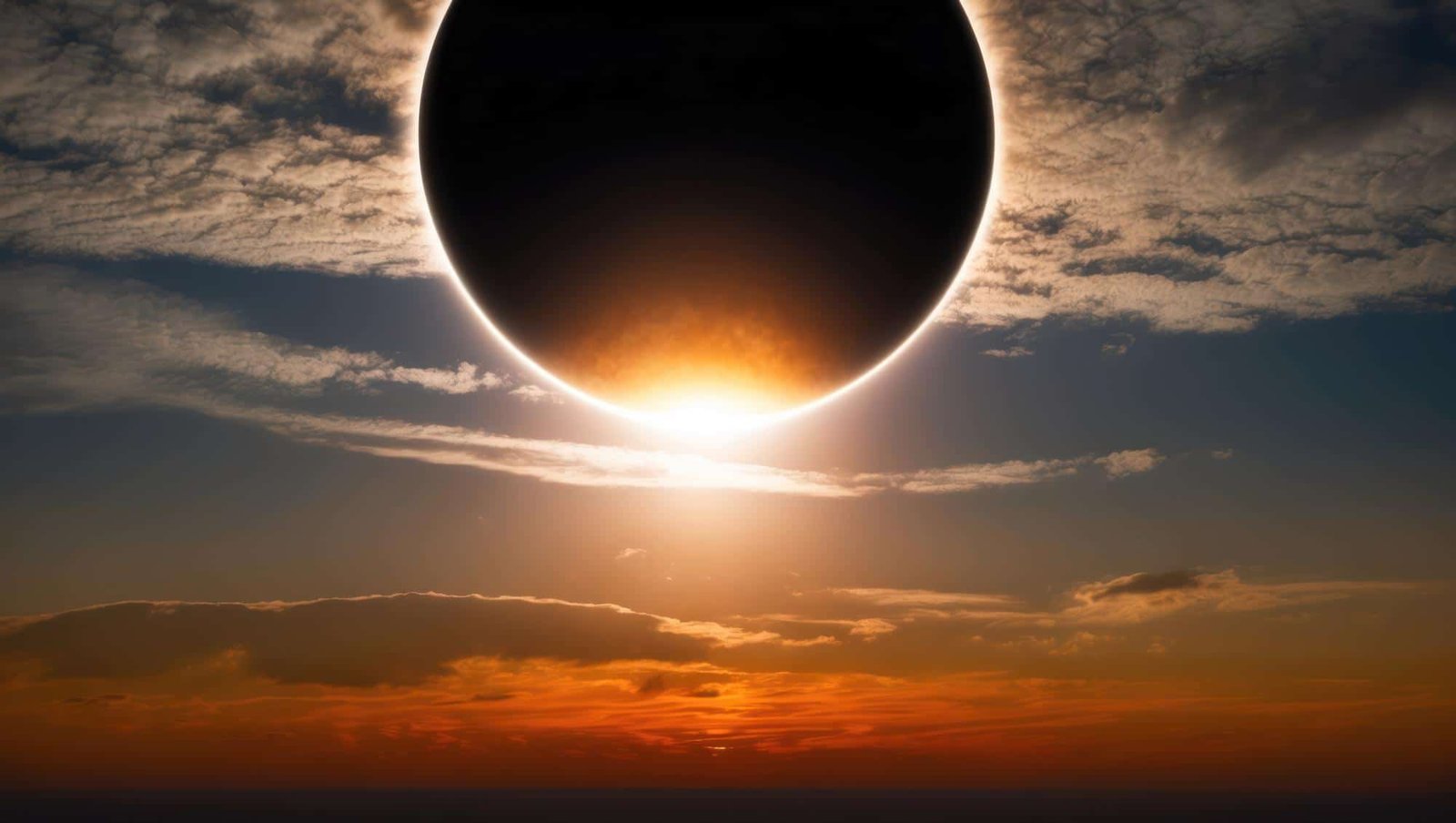
Not in a movie, not in a simulation, but for real. Streetlights will flicker on, birds will go quiet, and a strange chill will slide over cities that usually bake in the sun. The century’s longest solar eclipse now has an official date, and the countdown has quietly started.
यह वीनर्स नकली दांतों से 300 गुना बेहतर है! और कीमत बहुत सस्ती है
टूटे, टेढ़े, ढीले दांत! वीनर्स है इसका उपाए !
What sounds like science fiction is already mapped out, second by second, by astronomers with almost unnerving precision. The Moon will slide in front of the Sun and hold it there, stretching totality longer than anything this century has offered before or will offer again.
One ordinary day on the calendar is about to become the kind of date people remember for the rest of their lives. A day when noon will look like midnight.
The day the Sun goes missing
The news didn’t break with fireworks. It appeared in dry-looking tables and orbital charts: the century’s longest total solar eclipse has been pinned to a specific day, down to the heartbeat. On that day, the Moon’s shadow will carve a narrow, winding path across Earth, and for those standing in the right spot, daylight will simply… vanish.
Some will experience a ghostly twilight. Others, right on the “centerline” of the eclipse, will see the Sun completely swallowed for an unusually long stretch of time. We’re talking several precious minutes when the world will shift into an almost alien light. For a brief window, people will literally see the stars at lunchtime.
In a small village somewhere along that path, kids will remember being pulled out of school to stare at the sky, adults will pause their routines, and traffic will slow to a crawl. The shadows on the ground will turn sharp and strange. Dogs may whine, confused. A few people will cry without fully knowing why. We’ve all had those moments when reality feels slightly off; this will be one of those, on a planetary scale.
If past eclipses are any guide, hotels months away from the path are already starting to fill up for that date. During the 2017 total eclipse in the US, tiny towns saw their populations multiply in a single day. Local airports jammed with private planes, highways clogged at dawn, and pop-up viewing parties appeared in fields and parking lots. You’ll see the same thing again — just bigger, and along a different strip of Earth.
Figures from that 2017 event suggest more than 200 million people watched it in some form, on screens or with their own eyes. This one, with its record-breaking totality, will likely pull in even more. There will be families driving all night just to cross into the zone of darkness, couples turning it into a once-in-a-lifetime trip, and scientists hauling truckloads of instruments to chase a few extra seconds of data.
Those numbers, though, don’t capture the quieter impact. After the last major total eclipse over Europe in 1999, psychologists recorded spikes in people reporting a sense of “awe” and “reframing” of their everyday problems. Several studies now link rare natural spectacles to changes in how people rate their own happiness and perspective on life. A long, deep totality gives that feeling more time to sink in.
The reason this eclipse will be the longest of the century comes down to geometry and timing. The Earth, Moon, and Sun are constantly moving in slightly wobbly, slightly messy orbits. Once in a long while, things line up so that the Moon is just the right distance from Earth to appear *slightly* bigger than the Sun in the sky, and the Earth is positioned in a way that the shadow lingers.
When the Moon is closer to us, it looks bigger and blocks the Sun more fully. When Earth is near its farthest point from the Sun, the Sun appears a bit smaller. Stack those conditions together, and the path of totality stretches in both length and duration. Astronomers have crunched these numbers far into the future, and for this century, this is the peak moment: the longest full blackout we’ll get.
It’s not just poetic. That extra time in darkness gives researchers a rare laboratory in the sky. The Sun’s fragile outer atmosphere, the corona, explodes into view during totality. For a few precious minutes, telescopes can grab data that satellites usually struggle to collect because of blinding sunlight. A few extra seconds can mean entirely new insights into solar storms that influence our power grids, GPS and even the flights we take.
How to be ready when day turns to night
Planning for a total solar eclipse is a little like planning for a festival that only lasts four minutes, and can’t be delayed if you’re late. The first step is simple: get on the path of totality. Being 100 km off won’t cut it. Outside that narrow band, you only get a partial eclipse, and that’s like listening from the car park while the concert plays inside the arena.
The practical move is to pick two or three possible towns along the eclipse path, then watch both the long-term climate data and the short-term forecasts as the day gets closer. Some regions have a higher probability of clear skies at that time of year. That doesn’t guarantee anything, but it tilts the odds. Think of it as buying better seats, not buying certainty.
Then comes gear. You need certified eclipse glasses that meet international safety standards. Not sunglasses. Not smoked glass. Not a quick DIY trick found on a random forum. A small pair of paper eclipse viewers costs less than a lunch and can literally protect your eyesight for life.
Soyons honnêtes : nobody reads the tiny safety instructions printed on the side of those glasses. Yet staring at the uneclipsed Sun can burn cells in the retina without pain, leaving a permanent blind spot. Most experts recommend using eclipse glasses or a viewer for all partial phases. Only during the brief, full totality — when the Sun is completely covered and you see the black disc surrounded by a silver halo — can you safely look with the naked eye, and even then only until the first bright “diamond ring” appears again.
Common mistakes repeat from eclipse to eclipse. People underestimate travel time and get stuck in traffic just short of the path. Others arrive with no backup plan for clouds, then spend totality standing in a parking lot under overcast skies, staring at a darkened day but missing the main show in the sky. Some bring telescopes or cameras they’ve never used, fumbling with settings while the eclipse quietly comes and goes overhead.
There’s also the emotional side, which almost nobody plans for. Many veteran “eclipse chasers” say they were shocked by how intense their first totality felt — a mix of awe, fear, and a strange kind of joy. If you’re with kids, they might be thrilled or frightened when the world suddenly darkens. Talk it through before. Treat it less like a science demo and more like watching a storm roll in together, but with the volume turned down and the weirdness turned up.
“You go for the science or the novelty,” says one long-time eclipse hunter, “but in those few minutes, something flips. You’re not just looking at the sky anymore, you’re feeling your place under it.”
To keep your day grounded and smooth, a few practical pointers help:
- Arrive at least a day early to avoid last-minute traffic chaos.
- Pack extra certified eclipse glasses for friends and strangers alike.
- Have a simple, tested way to take photos — or decide not to and just watch.
- Save local maps offline; mobile networks often jam under heavy crowds.
- Bring layers, snacks and water — totality is short, but the waiting can be long.
*Most people who regret their eclipse experience say the same thing afterward: they spent too much time fiddling with gadgets and not enough time just looking up.*
What this eclipse says about us
There’s a quiet irony here. While global news cycles spin through politics, wars, climate, culture wars, and the next big AI tool, the date that might end up etched in millions of memories is fixed by celestial mechanics, not by human agendas. On that day, nothing we argue about online will stop the Moon’s shadow sweeping in, right on schedule.
The longest eclipse of the century is going to be a shared event, even for people who never step into totality. Social feeds will fill with eerie midday darkness, shaky phone videos of crowds gasping as the last shard of sunlight disappears, and wide shots of cities under a sudden twilight dome. For a brief window, we’ll all be staring in roughly the same direction, trying to describe a feeling that doesn’t quite fit into words.
That’s part of the strange power of eclipses: they hit us in the head and the gut at the same time. Logically, you know exactly what’s happening — orbital dynamics, predictable alignments, sunlight blocked at a specific angle. Yet when the light drops, your body reacts like something ancient just woke up. Heart rate shifts. Time stretches. Everyday worries shrink a little.
Some people walk away unchanged. Others quietly reroute parts of their lives afterward, change jobs, end or start relationships, move cities. Not because the eclipse “meant” something in a mystical sense, but because it cracked the routine open just enough to let a new thought in. Those few minutes of stolen night can act like a mirror, pointed not at the sky, but at us.
And long after the scientists have filed their data and the path of darkness has slid off into another ocean, stories from that day will keep surfacing at dinner tables, in classrooms, in late-night conversations. “Were you there?” “Where did you watch it?” “Did you see the stars come out?” It becomes a quiet reference point in personal timelines, like a wedding, a birth, a storm, a blackout.
The date is set. The orbits are locked in. Between now and that strange day, we’ll keep scrolling, arguing, building, worrying. Then, for a few minutes in the middle of an ordinary day, the Sun will disappear, and a century-sized shadow will remind us just how small — and how lucky — we are to be here watching.
| Point clé | Détail | Intérêt pour le lecteur |
|---|---|---|
| Date et durée record | Eclipse la plus longue du siècle, totalité de plusieurs minutes sur une trajectoire précise | Savoir pourquoi cet événement est unique et pourquoi cette date mérite d’être notée |
| Où et comment l’observer | Nécessité d’être sur la bande de totalité, préparation du trajet et du matériel certifié | Maximiser ses chances de voir l’éclipse dans des conditions sûres et spectaculaires |
| Impact humain et émotionnel | Mélange d’émerveillement, de vertige et de remise en perspective du quotidien | Mesurer que l’expérience va au-delà de la simple curiosité scientifique |