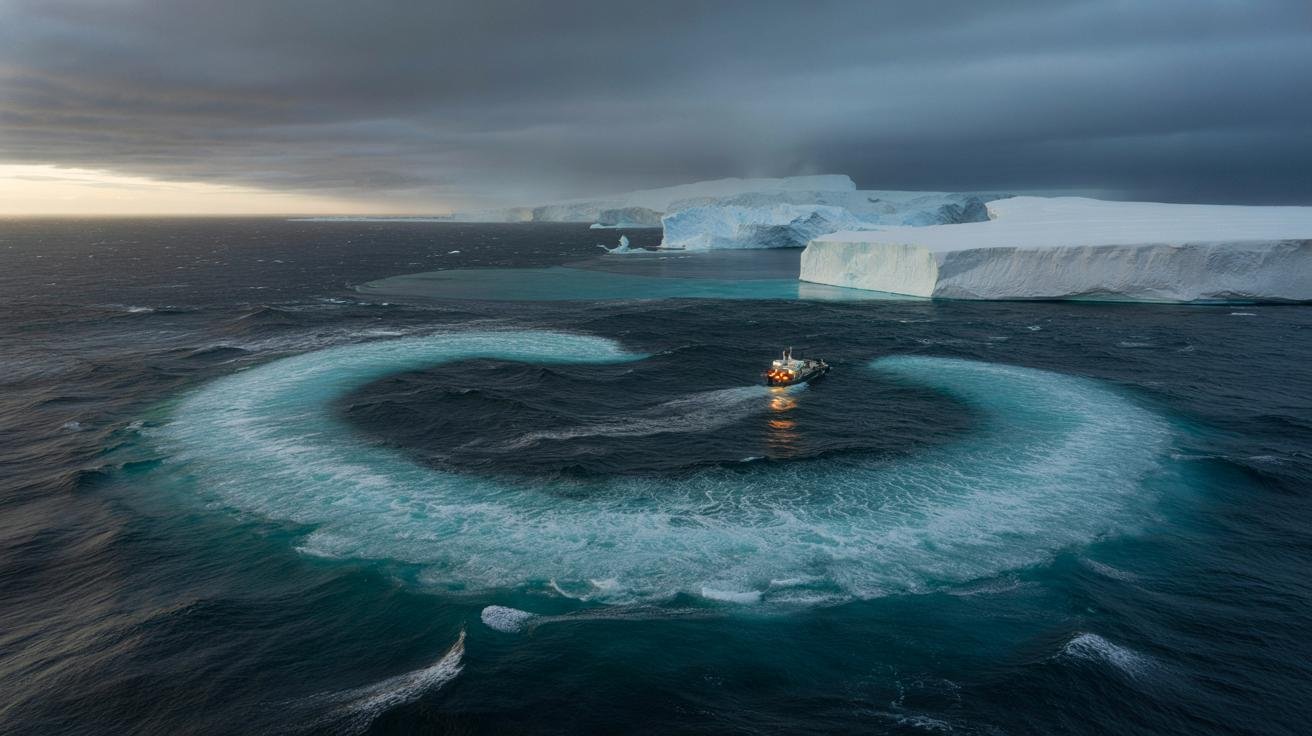
The first time I saw the Southern Ocean, I remember the wind more than the waves. It came in sideways, sharp as glass, carrying this low, endless roar from a sea that never really calms down. Scientists on the small research vessel moved with the ease of people who’d accepted that nothing here is ever still, or simple, or quiet. The ship’s instruments hummed softly, drawing invisible lines through the water — charts of currents that usually behave like the planet’s slow, steady heartbeat.
Last month, that heartbeat skipped.
Far below the surface, a major current in the Southern Ocean briefly reversed direction — something researchers had never seen before at this scale. It wasn’t a glitch on a screen. It was a warning.
The day the ocean flowed the “wrong” way
For decades, oceanographers have treated the Antarctic Circumpolar Current like the world’s conveyor belt. It loops around Antarctica, linking the Atlantic, Pacific, and Indian oceans into one massive system. Most of the time, it’s so consistent that ships and satellites can use it almost like a reference line: always there, always pushing enormous volumes of water eastward.
In late 2025, that pattern cracked. High-resolution floats and underwater sensors picked up something nobody expected — a deep branch of the current slowed, stalled, then began flowing backward for several hours. Not at the surface, where storms can briefly flip things. Deep down, where change usually moves at a glacial pace.
On one of the research vessels south of Tasmania, a young technician reportedly thought his instruments were miscalibrated. He rebooted them, checked the cables, cursed the software. He wasn’t alone. In several labs around the world, scientists watching incoming data feeds did the same thing: they assumed error, not upheaval.
Then different instruments, on different ships, run by different countries, all told the same story. A key branch of the Southern Ocean circulation had reversed direction in sync with a record-smashing inflow of fresh meltwater from Antarctic ice shelves. The reversal didn’t last long, but it was enough to rattle people who work with million-year climate records every day. Climate models had warned of a slowdown. A full flip — even a temporary one — was a different kind of headline.
The explanation, in cold scientific terms, sounds almost simple. Warmer oceans eat away at Antarctic ice shelves from below. That ice releases huge pulses of fresh, lighter water into the surrounding seas. Salty water is heavier, so normally it sinks, driving deep currents that circulate heat and nutrients around the globe. When too much fresh water floods the system, that sinking engine sputters.
Now imagine that process pushed to the point where the density contrast flips in certain layers. The water that should be dropping starts staying near the surface. The water that should be feeding the conveyor stalls, curls, and briefly runs uphill against its own history. *That’s what the new data appears to capture: a system flexing so hard it bent its own rules, if only for a moment.*
What this means for the rest of us, far from Antarctica
So what do you actually do with the news that a distant ocean current went backwards? You can’t reboot the planet like that technician rebooted his instruments. You can’t fly to Antarctica with a wrench. But there are still concrete levers, from your own life up to city and national decisions, that connect directly to this story.
Think in terms of pressure. Every tonne of CO₂ released into the air adds pressure to the climate system. Less pressure, less risk of abrupt flips. More pressure, more chance that “rare anomalies” become the new normal. The first gesture is almost boring: cut that pressure wherever your hand reaches — heating, transport, food, the vote you cast, the company you work for. Boring, yes. But it directly shapes the pace at which those Southern waters change.
There’s a shared fatigue around climate advice. We’ve all been there, that moment when you hear “use public transport, eat less meat, insulate your home” and you just feel… tired. That fatigue is real, and ignoring it doesn’t help.
Still, here’s the plain truth: **those small shifts scale fast when millions of people lean the same way**. Choosing a heat pump over a gas boiler, trading one short flight for a train, joining a local energy cooperative — none of it “saves the world” alone. Together, they slow the rate at which we heat the Southern Ocean and melt Antarctic ice. That slower rate buys time for coastal cities to adapt, for grids to decarbonize, for farmers to adjust to new rainfall patterns. Time, now, is everything.
The bigger mistakes usually aren’t technical. They’re emotional. One is thinking “it’s already too late, so nothing matters.” Another is waiting for some perfect, heroic solution before moving at all. Both keep the pressure dial stuck on high.
“Systems don’t collapse overnight from a single blow,” says Dr. Lena Ortiz, an oceanographer who studies Southern Ocean circulation. “They wear down quietly, get pushed past thresholds, then jump. Every bit of warming we avoid lowers the odds of one of those jumps.”
- Watch the signals — Pay attention to reports on Antarctic melt, sea-level projections, and ocean circulation. These are the canaries in the planetary coal mine.
- Lean on collectives — Neighborhood groups, unions, and professional networks can push for building retrofits, clean fleets, and local resilience at a scale individuals can’t touch.
- Back ocean science — From citizen pressure on funding to supporting campaigns that protect Southern Ocean research zones, keeping eyes on this region is a form of climate insurance.
A fragile heartbeat, and what comes next
The idea of the Southern Ocean current reversing sounds like the premise of a disaster movie, yet the reality is quieter and stranger. No skyscraper-sized waves, no instant ice age. Just a subtle flip detected by machines drifting in black, freezing water thousands of kilometers from any city. Still, the implications stretch right into your kitchen, your mortgage, your grocery bill.
That circulation helps lock huge amounts of heat and carbon deep in the ocean instead of leaving them in the air. If it falters more often, or for longer, more of that heat stays near the surface. Weather patterns warp. Storm tracks shift. Fisheries wobble. Insurance maps get redrawn. **A current changing direction is really a story about power rearranging itself across the whole climate system.**
There’s no satisfying plot twist where one new technology fixes the Southern Ocean. Some solutions are already on the table: rapid emissions cuts, protecting Southern Ocean ecosystems, halting deep-sea mining plans in the region, funding long-term monitoring instead of short election-cycle projects. Others are still half-formed: experimental carbon removal, floating solar, smarter ways to share energy across continents.
Let’s be honest: nobody really does this every single day — wake up and think about faraway currents before making a choice. Most days, you think about your job, your kids, the rent, that text you forgot to answer. Yet these choices, scattered across billions of lives, feed back into the same system that just flinched under Antarctica. The Southern Ocean’s brief reversal is a reminder that the climate machine is not a smooth, predictable slide. It has tripwires. Some we know. Some we’re only meeting now.
Maybe the most unsettling part is also the most motivating: we’re alive at the exact moment when this giant, ancient engine is wobbling — and still, just barely, steerable. The data from those drifting instruments is not destiny. It’s a snapshot of a system under stress that hasn’t yet snapped.
From here, the story branches. One version has more reversals, more shocks, a patchwork of emergencies and expensive fixes. Another has fewer surprises, more planning, a slow, messy transition away from fossil fuels that feels frustrating while it’s happening and obvious in hindsight. Which version wins will be written in building codes as much as in parliaments, in what banks fund and what they quietly drop, in what you normalize in your own circle. The Southern Ocean just sent a message, in the only language it has: flow, heat, and sudden hesitation. What we do with that hesitation is still wide open.
| Key point | Detail | Value for the reader |
|---|---|---|
| Southern Ocean reversal as warning | A deep branch of the Antarctic Circumpolar Current briefly flowed backward, linked to record meltwater | Helps you grasp why distant polar changes directly affect weather, seas, and costs in daily life |
| Human-scale levers matter | Cuts in emissions, energy choices, and political pressure reduce stress on ocean circulation | Shows concrete actions that lower the risk of abrupt climate “jumps” |
| Future still open | Circulation is wobbling, not yet broken; policy, finance, and lifestyle shifts shape what comes next | Offers a frame that balances urgency with agency, instead of paralysis |
FAQ:
- Question 1What exactly reversed in the Southern Ocean, and for how long?
- Answer 1Instruments detected a temporary reversal in a deep branch of the Antarctic Circumpolar Current, lasting several hours in a specific region. The main surface flow kept moving eastward, but the deep anomaly is what alarms scientists, because that deep circulation normally changes very slowly.
- Question 2Does this mean the global climate system is already collapsing?
- Answer 2No, not collapsing, but showing signs of serious strain. Researchers see the reversal as a stress signal, consistent with accelerated Antarctic melt and warming oceans. It raises the odds of more abrupt shifts if emissions stay high, rather than proving that collapse is locked in.
- Question 3How could a current change direction affect my daily life?
- Answer 3That circulation helps regulate global temperatures, sea-level rise, and storm patterns. If it weakens or flips more often, you’re more likely to feel it as harsher heatwaves, heavier downpours, coastal flooding risks, volatile food prices, and higher insurance costs.
- Question 4Is there any way to “fix” the Southern Ocean directly?
- Answer 4There’s no simple, targeted fix. The most direct lever is cutting greenhouse gas emissions quickly to slow ocean warming and Antarctic melt. Supporting strong climate policy, protecting Southern Ocean ecosystems, and funding long-term monitoring all reduce the risk of pushing the system past critical thresholds.
- Question 5How reliable is this reversal data — could it be a measurement error?
- Answer 5Initial skepticism was high, but the signal appeared across different instruments, from different research programs, in the same region and timeframe. That convergence makes a pure error unlikely, though scientists are still refining exactly how and why the reversal unfolded.