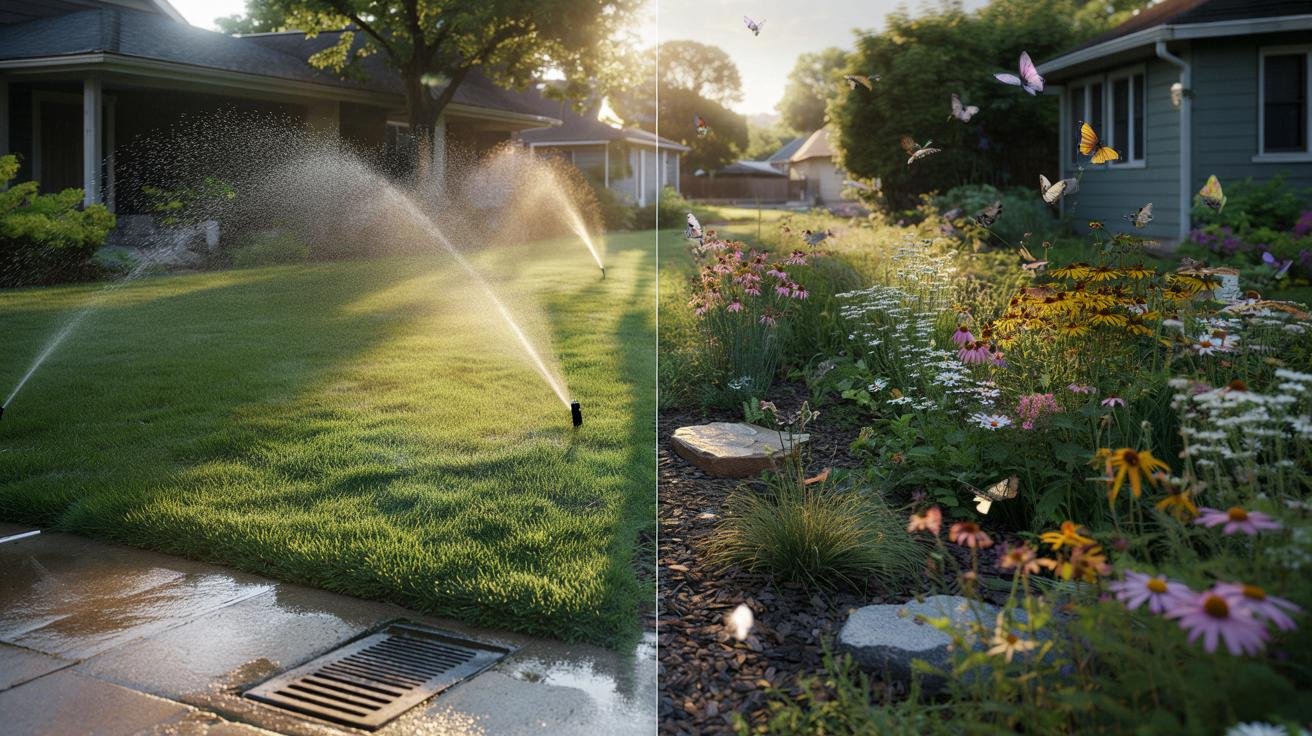
The sprinkler clicked in the dark like a metronome, flinging arcs of water across a perfect green lawn. On the sidewalk, the air felt cooler from all that evaporation, but the street gutter told the real story: a thin river of clean drinking water, racing straight into the storm drain. Two houses down, nothing moved. No hiss of sprinklers. No blank, clipped grass. Just a small front yard buzzing with life — purple coneflowers, milkweed, yarrow, and a slow-motion cloud of butterflies wobbling from bloom to bloom.
The lawn looked like a carpet sample from a catalog. The butterfly yard looked like someone had left a patch of quiet meadow in the middle of suburbia. One yard drank hundreds of gallons a week. The other barely sipped. At the curb, you could almost feel the choice sitting there between the two.
One kind of beauty needs constant watering. The other brings its own wings.
A thirsty habit hiding in plain sight
On paper, lawns seem harmless. Just grass, right? Soft under bare feet, easy to mow on Saturday, green enough for the Google Maps satellite view. Yet once you start looking, you notice the hoses, the timers, the sprinkler heads popping up like little robots at dawn. You notice how fast the ground dries, how quickly that green fades if the irrigation stops for a week.
In hot states like California, Nevada or Arizona, those weekend watering sessions add up fast. Some estimates say outdoor irrigation can swallow up to 50–70% of a household’s water use. In summer, that can mean thousands of gallons just to keep a yard looking like a golf course. Then there are bans during drought years, neighbors snapping photos of “water wasters”, and the low-level stress of watching your grass go patchy and brown.
The strange part is that most people don’t even like mowing. Or edging. Or tinkering with broken sprinkler heads. Lawns have just become this default setting we rarely question. A habit inherited from English estates and post-war suburbs, clung to even as climate charts and water bills tell us the story has changed.
Promoted Content
A tiny prairie that barely touches the tap
Spend a summer afternoon in a true butterfly garden and your sense of “normal” shifts a little. One homeowner in Austin ripped out most of his front lawn and planted native salvias, milkweed, black-eyed Susans, and native grasses. Neighbors thought he’d gone a bit wild at first. Then came the monarchs, swallowtails, skippers, bees, and dragonflies. The yard hummed at dusk like a small airport.
Here’s the part that gets people to lean in: he cut his outdoor water use by roughly 75%. Once the native plants were established, he turned off the automatic sprinkler and used a simple soaker hose just a couple of times in the deepest heat. The soil stayed shaded, the mulch held moisture, and the deep roots shrugged off dry spells that would have fried a shallow-rooted lawn in days. His water bill dropped. His maintenance hours dropped. The wildlife traffic increased.
This isn’t some rare miracle yard. Cities from Tucson to Denver to Minneapolis are full of examples. Xeriscaped front gardens. Pollinator strips. Tiny urban prairies squeezed between driveway and sidewalk. The pattern repeats: native or drought-tolerant plants use far less water, need less fuss, and bring far more life. Grass can host a soccer game. A butterfly garden can host an entire food web.
Why lawns guzzle and wildflowers sip
The science behind this is simple and pretty humbling. Turf grass has shallow roots, often just a few inches deep. Under summer sun, that thin layer of soil heats up fast. Water evaporates. Roots dry out. You irrigate. Repeat. Most ornamental grasses were never meant for your local climate, which makes them needy tenants from the start.
Native perennials play a different game. Many send roots down a foot, two feet, sometimes more. They tap cooler, deeper moisture in the soil. Their leaves are adapted to the local sun and wind, shaped to lose less water to the air. When rain comes, healthy soil full of roots and fungi acts like a sponge, holding onto that gift instead of letting it rush away. *A butterfly garden is basically a water-saving machine disguised as flowers.*
There’s also a quiet resilience in this kind of yard. A week-long heat wave? The plants droop a little, then bounce back. A surprise downpour? The soil and roots soak it up instead of sending a flood toward the street. Lawns fight the climate. Butterfly gardens work with it. That’s the plain truth most sprinkler ads don’t mention.
How to start swapping grass for wings
You don’t have to bulldoze your entire lawn overnight. The smartest moves often start small, like claiming one sunny corner by the driveway. Lay down cardboard or a thick layer of newspaper on top of the grass, cover it with mulch, and let that patch smother for a few weeks. Then plant right into that softened ground — milkweed, asters, coneflowers, or whatever native nectar plants your local nursery recommends.
Water those new plants deeply for their first season so their roots dive down, not sideways. After that, you can taper off. Think slow, infrequent watering instead of the daily sprinkler mist that barely penetrates the soil. A simple rain barrel under a downspout can cover most of their needs in many climates. You’re training the garden to be tough from the start, not spoiled.
Promoted Content
Once you see the first caterpillars munching a leaf, or a monarch spiraling down like a tiny orange parachute, that little patch starts to feel like something bigger than “landscaping”.
Friendly pitfalls and easy wins
There’s a common fear that a butterfly yard will look “messy” or annoy the neighbors. That happens when plants get too tall near the sidewalk, or when there’s no visible structure. Start with clear edges: a simple stone border, a narrow strip of low groundcover along the path, maybe a small sign that says “Pollinator Habitat” so people know it’s intentional, not neglect. Neighbors forgive a lot once they understand the story.
A big mistake is choosing random pretty flowers from the garden center without checking if they’re native or actually useful to butterflies. Many hybrids have showy petals but little nectar or pollen. Some butterfly favorites: milkweed for monarchs, dill and fennel for swallowtail caterpillars, and late-season asters or goldenrod for fall fuel. And be gentle with chemicals. One blast of broad-spectrum pesticide can turn your “butterfly haven” into a silent movie overnight.
Let’s be honest: nobody really does this every single day. You’ll forget to weed for a week, or you’ll buy a plant just because you like the color. That’s okay.
“I stopped trying to win Yard of the Month and started trying to win ‘Yard with the Most Butterflies,’” a neighbor in my block joked. “Turns out, the butterflies have much looser standards.”
- Use layers — low groundcovers, mid-height flowers, and a few taller plants give butterflies shelter and visual rhythm.
- Add a shallow water dish with stones — butterflies need safe landing pads to drink and “puddle.”
- Leave some chewed leaves — those holes mean caterpillars are eating, which means more butterflies incoming.
- Plant in clusters — groups of the same flower are easier for butterflies to spot than single scattered stems.
- Skip the perfect cleanup — a few seed heads and dry stems over winter help insects survive until spring.
A different kind of status symbol
Once you’ve watched a monarch lay eggs on your milkweed and then seen its striped caterpillars fatten up day by day, grass starts to feel strangely empty. You begin to notice how sterile many “nice” yards are — trimmed, tidy, and almost silent. The hum of wings becomes its own soundtrack, and suddenly the idea of dumping hundreds of gallons on a lawn just for color feels out of step with the times.
There’s a subtle social shift happening, too. In some neighborhoods, the “fancy” yard used to be the one with the greenest, most uniform turf. Now the yard that turns heads is the one buzzing with bees and speckled with blooms through three seasons. Cities are catching up, offering rebates for turf removal and publishing lists of recommended drought-tolerant plants. Kids start learning the names of butterflies instead of just hearing “don’t walk on the grass.”
You don’t need a manifesto to play your part. Just a small rebellion against the idea that a respectable yard must drink like a camel. A few native flowers, a patch of earth left a little looser, a decision to water life that gives back. The next hot summer evening, when the sprinklers across the street hiss to life and your garden stays mostly quiet, you might find yourself smiling as a swallowtail drifts past. The future of the suburban yard may not be a perfect rectangle of green — it might be wings, color, and soil that remembers how to save its own water.
| Key point | Detail | Value for the reader |
|---|---|---|
| Lawns are heavy water users | Turf grass needs frequent irrigation due to shallow roots and exposed soil | Helps explain high water bills and drought restrictions |
| Butterfly gardens use far less water | Native perennials have deep roots, better soil cover, and built-in drought tolerance | Shows a realistic path to cutting outdoor water use by up to 50–75% |
| Small changes make a big impact | Starting with one converted patch, edging, and key host plants | Makes the transition feel doable for any yard size or budget |
FAQ:
- Question 1Do I have to remove my entire lawn to help butterflies and save water?Not at all. Even converting 10–20% of your lawn into native planting beds can dramatically cut watering and attract visible numbers of butterflies.
- Question 2Will a butterfly garden attract pests or snakes?What it mainly attracts are insects, birds, and small wildlife that already live nearby. Good plant diversity usually balances pests, and keeping paths clear and visibility open limits unpleasant surprises.
- Question 3How long before I can reduce watering in a new butterfly garden?Most native perennials need one full growing season of deeper, occasional watering to establish roots. After that, many cope with only rain or occasional supplemental water.
- Question 4Can I still have a play area or dog space without a big lawn?Yes. Many people keep a smaller “functional” grass area while turning the rest into drought-tolerant planting, gravel paths, or mulched zones.
- Question 5Do butterfly gardens look dead in winter?Some plants go dormant, but seed heads and stems can be beautiful in a different way and support overwintering insects. You can also choose evergreens and grasses to keep structure year-round.